
THOTCON 0xD Badge
A Tamagotchi with a touch wheel
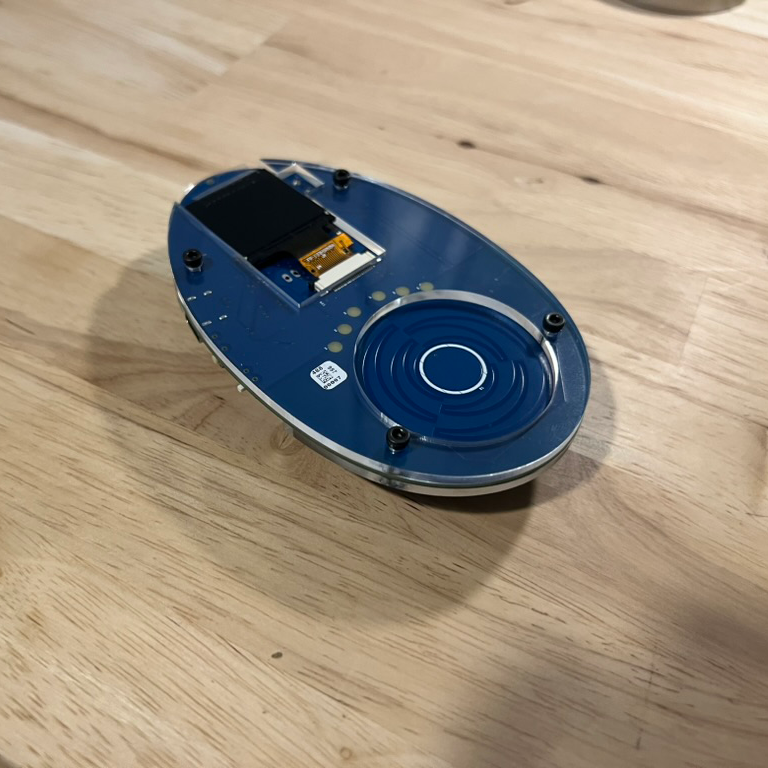
THOTCON asked for a Tamagotchi. We built 2,000 egg-shaped badges with a screen, a touch wheel, and a village to look after, and shipped them in six months.
Specs
- Event
- THOTCON 0xD, Chicago, May 30–31, 2025
- Made
- 2,000 badges in six months
- Chip
- ESP32, on SparkFun's ESP32 Thing design
- Screen
- 1.3-inch IPS TFT
- Controls
- Capacitive touch wheel, 32 mm, etched into the board
- Board
- 1-oz copper, 8 mil traces and gaps
- Shell
- Laser-cut acrylic, M2.5 bolts
- Network
- Wi-Fi, over-the-air updates, MQTT
- Assembly
- Absolute Electronics (boards), Ponoko (acrylic)
The game
Every badge ran a village-building game with a Tamagotchi field. The village is an idle game meant to be played across both days of the conference, so it changes slowly whether you're watching it or not.
Badges could chat with each other. There were mini-games and quests, including a strange little synth, and live missions that players joined from their badges to earn points and level up their villages. Scores streamed to a stats board anyone could watch online.
We pushed firmware updates over the air during the event and added mini-games as the weekend went on. The game had a rough first morning, and parts of the badge got hacked more than once. People made it their own, which is what you hope for at a hacker conference.
The touch wheel
We started with paper cut-outs. They showed that a dial would sit well on an egg shape, and that a touch pad would be more comfortable than a dial that turns.
The wheel is three pads etched into the circuit board, based on an old Texas Instruments design. It took three pins on the ESP32 and no parts to place, which saved $4.38 a badge over a regular dial. It also gave the badge an iPod feel we liked.
The design is parametric, so we scripted the wheel's diameter instead of redrawing it each time the enclosure changed. Seven rounds got us to 32 mm, clear of the screen's ribbon cable and every mounting post.
Tariffs
The new tariffs landed just as we were bringing in parts. Our screens cost about $6,000. Customs coded them as televisions and billed a $10,000 tariff. After 16 hours on the phone with DHL the screens were recoded, and we paid $4,500 on a tariff aimed at fentanyl.
Putting 2,000 together
The shells are laser-cut acrylic. We prototyped them on a Glowforge, then had Ponoko cut 2,000.
The day before the event, about 15 volunteers spent what felt like forever bolting shells onto boards. Each badge took four nuts, four bolts, and a shell that had to be popped out of its sheet. We saved money and lost time, and next time we'll build a jig.
Who made it
- Designed and built by Fourfold. Jay Margalus led the design.
- Rudy Ristich wrote up the circuit board design.
- A lot of the firmware was written with help from Claude Code.
Build log
- Part 1: From Sketch to Early Prototype
- Part 2: Designing the PCB
- Part 3: The Firmware
- Part 4: Enclosures, Tariffs, and the Grind of Production
- Firmware update log from the event